
Running MEIC (multiple-entry iron condors) at Interactive Brokers
MEIC, the multiple-entry iron condor strategy for SPX 0DTE, opens several iron condors a day, each with a stop on both sides, and every one of those stops has to be working within seconds of the fill. Nobody runs that by hand for long. If you trade MEIC, or want to, and your account is at Interactive Brokers, the real question is which tool can run it there.
Important
This article is an example only. The MEIC rules and the VolNinja setup below show what the software can do; they are not trading advice, and not a recommendation to trade MEIC or any other strategy. Options trading carries substantial risk, 0DTE options especially. Test any setup in a paper account before you trade it live, and decide for yourself whether it suits you. See the risk disclosure.
The MEIC strategy, as Tammy Chambless trades it
MEIC has no official rulebook. When traders talk about it, the version they usually mean is Tammy Chambless's. She is the trader most associated with the strategy, having taught and presented it widely, so her rules are the reference this article uses. She is clear that it is not hers alone: "I did not originate this strategy. I have built on the work of others." Her slides from July 2023, 0 DTE SPX "MEIC+" Trading Techniques, set out how she trades it:
- Enter on a regular interval. She enters every 30 minutes from 1:00 PM Eastern, five times a day, on SPX options expiring that day.
- Each entry is an iron condor, entered or legged in as a put credit spread and a call credit spread.
- Aim for $0.80 to $1.50 of credit on each side, about $1.20 on average, on spreads 10 to 30 points wide.
- Stop each side at twice its own credit, and manage each side separately. A side sold for $1.50 stops at $3.00.
- No profit target: each side stays on until it is stopped or expires.
Her MEIC+ variation sets each stop $0.10 lower, at twice the credit minus $0.10, which turns days that would have ended at breakeven into a small profit.
VolNinja is not affiliated with or endorsed by Tammy Chambless.
Which MEIC automation tools work with IBKR
Four tools come up in most MEIC discussions: Trade Automation Toolbox, tradeSteward, Option Omega and Option Alpha. Three of the four do not connect to Interactive Brokers at all. Here they are, with VolNinja added:
| Tool | Brokers it trades through | IBKR |
|---|---|---|
| tradeSteward | Schwab, Tradier, tastytrade, TradeStation | no |
| Option Omega | Tradier, Schwab, tastytrade, TradeStation | no |
| Option Alpha | Tradier, TradeStation, tastytrade, Schwab | no |
| Trade Automation Toolbox | IBKR, TradeStation, Tradier, Schwab | yes, on Windows |
| VolNinja | IBKR | yes, on Mac, Windows or Linux |
Option Omega and Option Alpha each have a page of their own: Option Omega vs VolNinja and Option Alpha vs VolNinja.
TAT does trade through IBKR. It runs on a Windows PC or VPS, and its plans are priced by contracts per day. A MEIC day adds up quickly: her five condors at one lot is 20 contracts, and the every-ten-minutes schedule below is about 116. Our TAT comparison has its tiers.
VolNinja, our own tool, is built for IBKR. It installs as a desktop app on Apple Silicon Macs and on Windows, runs in Docker on Linux, and does not count contracts per day. The rest of this article sets MEIC up in it.
Setting up MEIC in VolNinja
VolNinja is an app that runs on your own machine and trades through your own IBKR account. MEIC takes two pieces in it: a template that describes one condor, and a strategy that opens it on a schedule. The video after this article walks through the whole setup on screen.
The setup below is not Tammy's MEIC. It is a variant built to show what the tool can do, with more entries, short strikes picked by delta and an optional take profit. You can run her version in VolNinja too: her stops carry over as they are, and the strategy section shows the three fields to change for her five entries from 1:00 PM.
The template: one condor
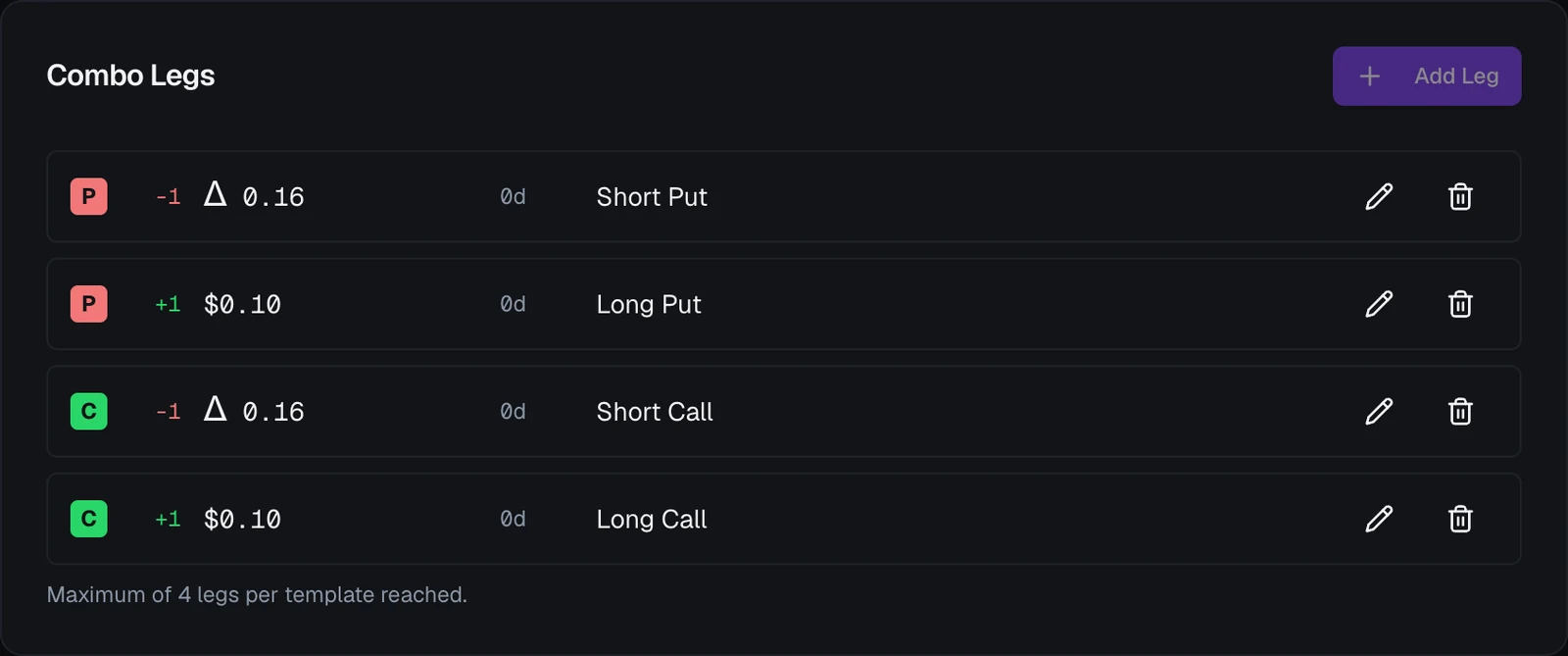
A template's legs pick their strikes when each condor opens, so every entry lands on the strikes of that moment rather than ones chosen in the morning.
| Leg | Action | Type | Expiry | Strike chosen by |
|---|---|---|---|---|
| Short Put | Sell | Put | today (0 DTE) | Delta 0.16 |
| Long Put | Buy | Put | today | Premium, $10 a contract |
| Short Call | Sell | Call | today | Delta 0.16 |
| Long Call | Buy | Call | today | Premium, $10 a contract |
The four legs go out as one combo order. Ten dollars a contract buys a cheap option further out, which caps what each side can lose.
The stops: one on each side
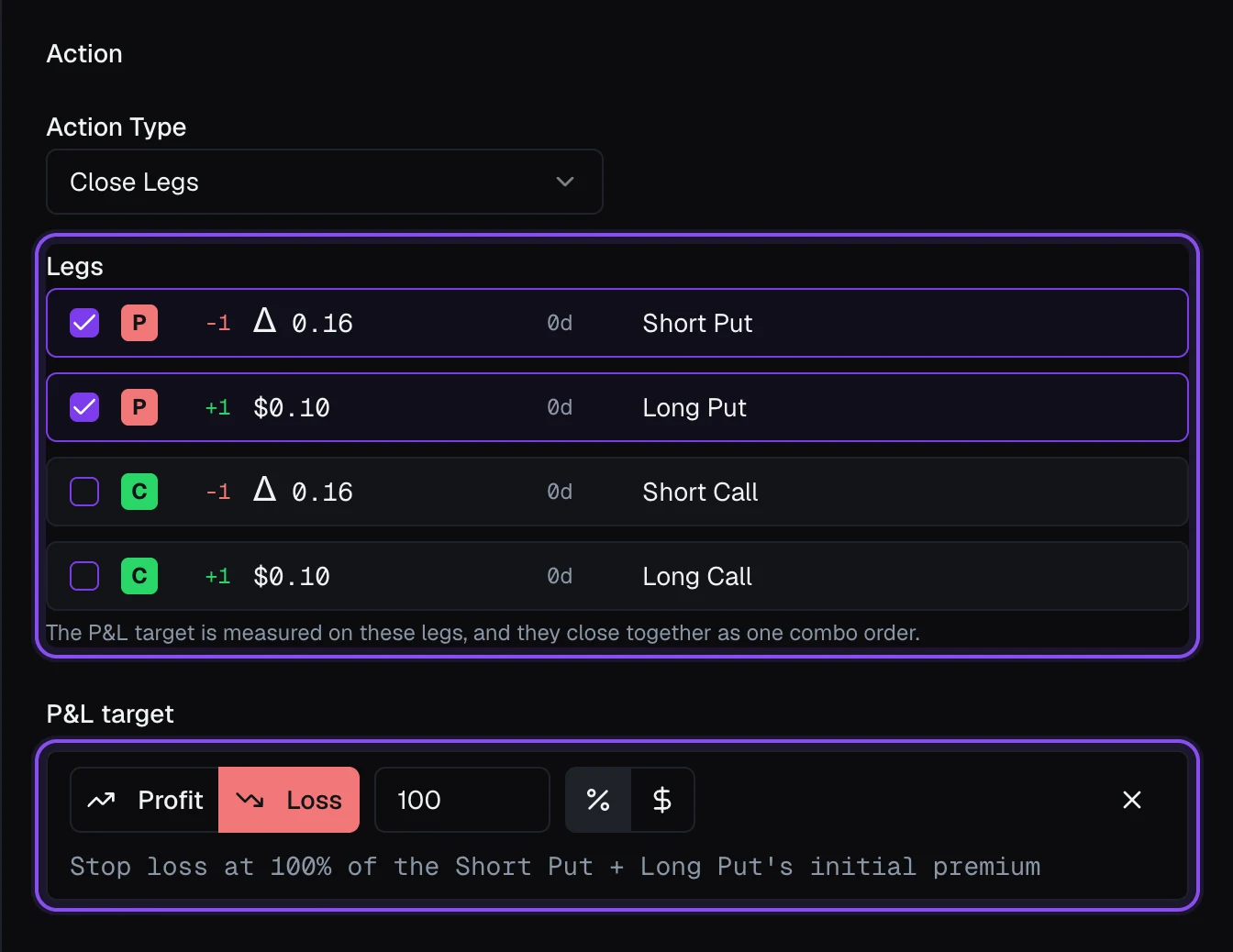
Each side gets its own rule, so a run in one direction closes only the side that is losing:
| Rule | Action | P&L target |
|---|---|---|
| Put side stop | Close Legs: Short Put and Long Put | Loss 100% |
| Call side stop | Close Legs: Short Call and Long Call | Loss 100% |
| Take profit (optional) | Close Position | Profit 50% |
When a rule closes two legs, its target is measured on those two legs together, and they close together as one combo order. Loss 100% fires when that side has lost the credit it took in: the put spread or the call spread has doubled. That is Tammy's stop, twice the side's credit, and with similar credit on both sides a day where one side stops and the other expires comes out about even.
Leave the take profit out to match Tammy's rules.
The strategy: the schedule
The strategy is one rule:
| Field | Value |
|---|---|
| Conditions | Current Time after 09:45, and Current Time before 14:30 (Eastern) |
| Action | Execute template: your condor template |
| Cooldown (s) | 600 |
| Max / day | blank |
| Only during market hours | on |
Both conditions must hold, so the rule can only fire between 09:45 and 14:30. The cooldown makes it wait ten minutes after each firing, which gives a condor at about 09:45, 09:55, 10:05 and so on until 14:25: around 29 a day.
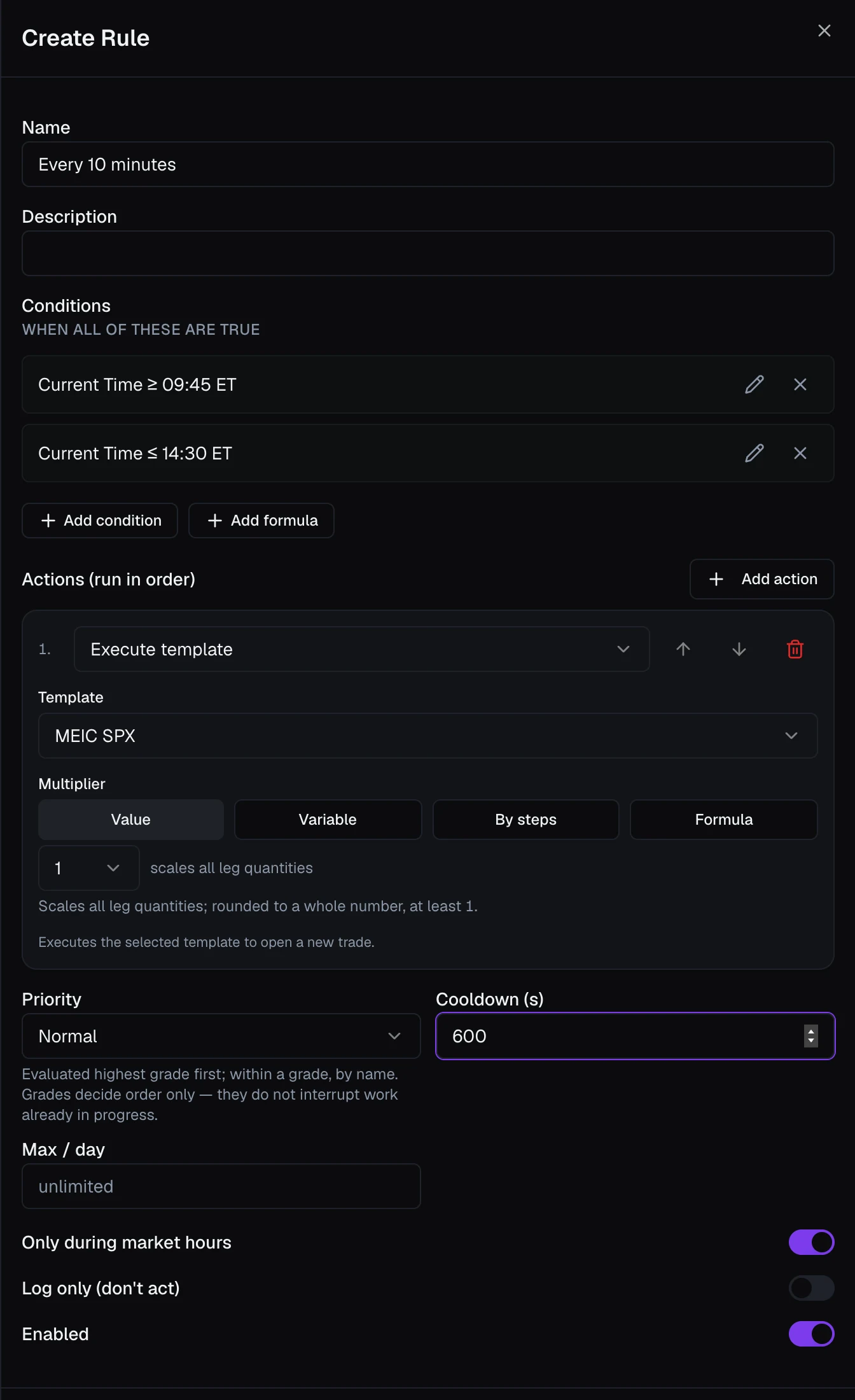
To trade her schedule instead, five entries 30 minutes apart from 1:00 PM, set the first condition to Current Time after 13:00, Cooldown (s) to 1800 and Max / day to 5.
Start the strategy in Paper first. From then on it opens the condors on schedule every day, and each one carries its own stops.
Running a second strategy beside it to manage the longs
Several strategies can run at once, and a strategy's rules can count positions across the whole account. One example splits the wings off the condor:
- Remove the two long legs from the condor template, which leaves a short strangle. VolNinja updates the two stops to match: each now closes only its short leg, with the target measured on that leg alone.
- Make a second template that buys only the two $10 wings.
- Add a strategy that counts the strangles still open from the first template, and runs the wings template whenever that count is greater than its own My Open Count, with a cooldown of 30 seconds.
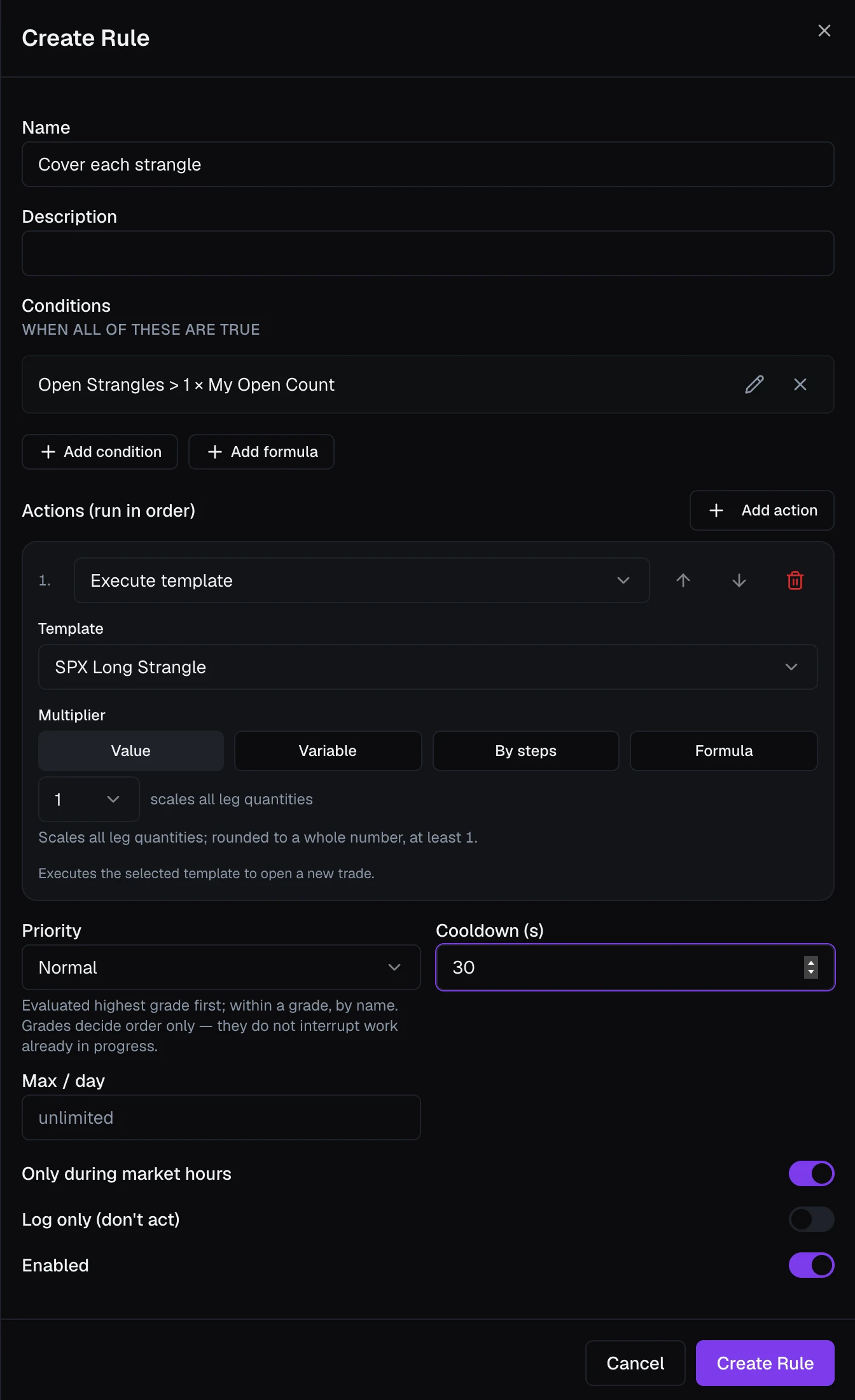
It buys one pair of wings for every strangle that does not have one. When a strangle is stopped out, its wings stay in the account and cover the next entry instead of being bought again. The same rule can also watch Maint. Margin, or any other condition you want alongside the count.
Your broker margins the account as a whole, so long options you already hold can offset new short ones; check how your account is margined before relying on it.
Run either setup in Paper for a while and watch how the entries and stops behave before you take it live. The guide covers running a strategy, template legs, management rules and where a rule runs.